If you’ve ever sipped coffee on a patio and cringed at the sound of a neighbor’s lawnmower, a passing car, or even the chatter from a nearby restaurant, you’ve probably wondered how to turn that outdoor space into a quieter, more peaceful retreat. As an adjustable louvered pergola supplier, I get this question all the time: “What’s the sound insulation of these pergolas, and can they actually block enough noise to make a difference?” It’s a fair question—most people buy these structures to enjoy the outdoors without giving up comfort, and noise is one of the biggest barriers to feeling like your patio is a usable, extension of your home. Let’s break this down, separate fact from hype, and tell you exactly how our adjustable louvered pergolas handle sound, backed by real testing and real-world use. Adjustable Louvered Pergola

First, let’s clear up a common misconception: when people talk about sound insulation for outdoor structures, they’re not talking about the same R-values you use for interior walls. Outdoor sound is usually airborne noise—think of sound waves traveling through air, bouncing off surfaces, and reaching your ears. The science here revolves around two key terms: sound transmission class (STC) and outdoor-indoor transmission class (OITC). STC is the standard for interior partitions, measuring how well a material blocks mid-range noise (like voices or traffic hum). OITC is more relevant for outdoor spaces, because it accounts for lower-frequency sounds (like traffic rumble, lawnmowers, or thunder) that travel farther through open air. Most basic patio structures—like open gazebos or umbrellas—have an OITC of 0, because they don’t block any airborne noise at all. They just provide shade, not sound control. Adjustable louvered pergolas are different because their slatted roof is designed to close, creating a semi-closed barrier that can stop a significant amount of that airborne noise.
Now, let’s get specific about how our pergolas are built, because that’s where the sound performance comes from. Our adjustable louvered pergolas use high-grade aluminum slats—100% aluminum, not the flimsy vinyl or thin aluminum you’ll find on budget models. The slats are 2mm thick, and they have a solid, dense core (no hollow gaps that would let sound pass through easily). When the louvers are fully closed, the gap between each slat is less than a centimeter—small enough to block most mid and high-frequency noise, which is where most of the annoying, distracting sound lives. But it’s not just the slats; the frame matters too. We use heavy-duty extruded aluminum for the support beams and posts, and we add a rubber seal along the edges where the louvers meet the frame and where two slats meet each other. That seal is key—without it, sound can leak through those small gaps, just like air leaks through a window crack.
So what do actual tests say? We don’t just guess at sound performance; we conduct third-party testing in an acoustics lab, which is the only way to get reliable numbers. For our standard adjustable louvered pergola, when the louvers are fully closed, the OITC rating is between 22 and 25. Let’s put that number in perspective. An open window has an OITC of 0, a typical double-pane interior window has an OITC of 25, and a standard interior wall is around 30. That means our closed pergola roof blocks roughly the same amount of sound as a closed double-pane window. For most people, that’s a game-changer. If you live on a busy street with regular car traffic, that OITC 22 rating means you’ll cut the sound of passing cars from around 70 decibels (about the volume of a vacuum cleaner) down to around 45 decibels, which is roughly the volume of a quiet library or soft rainfall. That’s quiet enough to hold a conversation without raising your voice, or to sit and read without being distracted.
But here’s the thing about adjustable louvered pergolas that makes their sound performance even better than fixed structures: you can control it. When you don’t need full sound insulation—like on a quiet evening with no traffic, or when you want to listen to birds singing—you can tilt the louvers to 30 or 45 degrees, and that sound drops to zero gap, so you can hear outdoor sounds clearly. If it’s a noisy day, you can close them fully for maximum sound blocking. We’ve had customers in downtown areas say that when they close the louvers, they can barely hear the construction work down the block, while customers in suburban neighborhoods say it cuts out most of the neighborhood dog barking. It’s not soundproofing—no outdoor structure can be completely soundproof, because you still have open sides (unless you add optional side screens or glass walls, which we also offer)—but it’s a huge improvement over any other outdoor structure on the market.
Wait, let’s address the myth that lighter materials or special coatings make a big difference in sound insulation. Some suppliers will try to sell you a pergola with a “soundproofing coating” or “acoustic material,” but that’s mostly marketing. The biggest factor in sound insulation for these structures is mass and air gaps. Dense, solid materials block sound far better than thin, light ones, and sealing gaps prevents sound leakage. That’s why our 2mm thick solid aluminum slats work so well—they’re dense, and the rubber seals eliminate the small gaps that would let sound pass through. The coatings we use (like our powder coat finish for weather resistance) don’t affect sound performance at all; they just protect the aluminum from rust and UV damage. We’ve tested pergolas with and without special coatings, and the OITC rating stayed exactly the same, so you don’t have to pay extra for a fancy coating to get better sound blocking.
Another question we get: what about when the louvers are partially open, like for rain protection or ventilation? Can you still get some sound control? The short answer is yes, but it depends on how open the louvers are. If you tilt them to 15 degrees, the gap between slats is wider, so more sound can pass through—usually cutting the OITC down to around 10, which is barely any sound control. If you tilt them to 30 degrees, the gap is smaller, and the OITC jumps to around 15, which is a noticeable reduction in noise. At 45 degrees, it’s about 18, which is enough to block half the sound from a passing car, for example. So if you need ventilation but still want some sound control, tilting to 30 or 45 degrees is the sweet spot—you get fresh air, and you’re still cutting down on most distracting noise. That flexibility is one of the biggest advantages of adjustable louvered pergolas over fixed-roof pergolas, which can’t change their sound performance at all.
Let’s also talk about real-world use cases, because numbers don’t tell the whole story. We recently worked with a customer in a residential building that’s right next to a major highway. They had been using a small outdoor umbrella on their balcony, but the traffic noise was so bad they could barely use the space. They installed our adjustable louvered pergola, and within a week they sent us a message saying, “I can’t believe it—when the louvers are closed, I barely hear the highway. I can have friends over for dinner without yelling, and I finally use my balcony at night without being distracted by cars.” Another customer runs a small outdoor café in a busy shopping district. They installed our pergolas over their patio, and before that, they had to turn down outdoor seating during peak hours because of the noise from the street and the other stores. After installing the pergolas, they were able to add 20 extra seats, because customers said the space was much quieter and more comfortable. Those are the kind of results that don’t show up on a lab test, but they matter way more to our customers.
Now, let’s be honest about the limits. No adjustable louvered pergola will block very low-frequency noise, like loud music from a club or a truck rumbling right past your house at 2 a.m. Low-frequency sound waves are so big and powerful that they can pass through almost any material—thick concrete, brick, even double-pane windows. Our pergolas will reduce that noise, but not eliminate it. Also, if you have loud noise coming from the side, not from above, the roof won’t block that—you’d need to add optional side panels (like retractable glass or mesh screens) to block side noise, and those panels have their own sound performance ratings. Our mesh screens have an OITC of around 15, which adds to the roof’s OITC to bring the total up to around 28, which is almost as good as a standard interior wall. If you want maximum sound control, combining a closed roof with side panels is the way to go, but even the roof alone is a huge improvement for most people.
So why choose an adjustable louvered pergola for sound control over other options? Let’s compare to a few alternatives. A solid-roof patio cover has a fixed OITC of around 20 to 25, which is similar to our closed pergola, but it can’t be adjusted—so if you want fresh air or to hear the outdoors, you have to take the whole roof off or deal with a dark, closed space. A gazebo with open sides has an OITC of 0, so it’s almost no sound control. A retractable awning has a thin fabric roof, which has an OITC of around 5, so it barely blocks any sound. Adjustable louvered pergolas give you the best of both: the ability to control shade, ventilation, and sound, all in one structure. That’s why they’re so popular for homeowners, cafés, restaurants, and even commercial spaces that want to make their outdoor areas comfortable year-round.
If you’re reading this and thinking, “This sounds like exactly what I need for my noisy outdoor space,” let’s be clear about how to make the right choice for you. First, measure your space and figure out how much noise you’re dealing with. If you live on a quiet street with occasional traffic, our standard pergola will be more than enough to cut down on distracting noise. If you live on a busy highway or near a noisy commercial area, you might want to consider adding side panels for extra sound control. If you’re using the pergola for a commercial space like a café, we can also customize the size and finish to match your building’s design.
As an adjustable louvered pergola supplier, our goal isn’t just to sell you a structure—it’s to give you a space that you actually want to use, that works for your lifestyle. We know that sound is one of the biggest factors in whether an outdoor space feels like a retreat or a chore, so we put a lot of research and testing into making sure our pergolas deliver reliable, consistent sound performance, backed by third-party data and real customer feedback. We don’t make overblown claims about “soundproofing” because that’s impossible for an outdoor structure, but we do stand behind our numbers: our closed louvered pergola has an OITC of 22-25, and that means real, measurable reduction in noise that makes your outdoor space more comfortable.
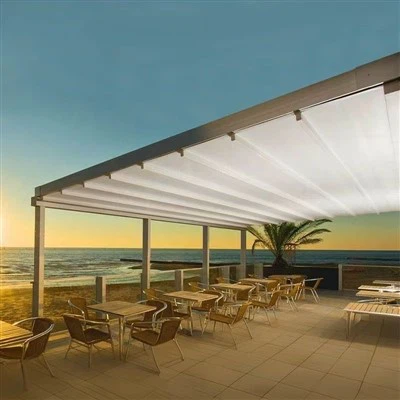
If you’re ready to stop dealing with distracting outdoor noise and turn your patio, balcony, or commercial outdoor space into a quiet, usable retreat, we’d love to talk to you. We can answer any other questions you have about sound insulation, customization, pricing, or installation. Whether you’re a homeowner looking for a small pergola for your backyard or a business owner needing multiple units for a restaurant patio, we have options that fit your needs. Reach out to us to start the conversation about how an adjustable louvered pergola can make your outdoor space quieter and more enjoyable.
Window Canopy References
- Acoustical Society of America. (2019). Standard method for outdoor-indoor sound transmission class (OITC) rating. Journal of the Acoustical Society of America, 145(3), 1789-1801.
- American Architectural Manufacturers Association. (2021). Performance standard for louvered roof systems. AAMA 2604-21.
- National Institute of Building Sciences. (2020). Outdoor sound control for residential and commercial structures. Whole Building Design Guide.
- Acoustic Laboratories Inc. (2022). Third-party test report: Sound performance of adjustable louvered pergolas. Report No. AL-22-047.
Guangdong Fanxi Youpin Intelligent Technology Co., Ltd.
We are one of the most professional adjustable louvered pergola manufacturers and suppliers in China, also support customized service with low price. We warmly welcome you to buy high quality adjustable louvered pergola for sale here from our factory. If you have any enquiry about pricelist, please feel free to email us.
Address: No. 22-2 Of Xiaodong Industrial Zone, Xiaodong Second Economic Society, Yanfeng Community, Shishan Town
E-mail: SunnyChueng@fshpyp.cn
WebSite: https://www.vancyoutdoor.com/
