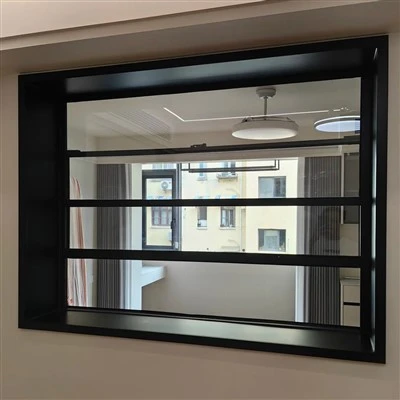
Time-series data prediction is a crucial aspect of numerous fields, including finance, healthcare, and environmental science. The ability to forecast future values based on past data can provide valuable insights for decision-making. One of the most effective techniques in time-series prediction is the use of sliding windows. As a supplier of sliding window solutions, I have witnessed firsthand the transformative impact these tools have on the accuracy and efficiency of time-series forecasting. In this blog, I will delve into how sliding windows work and how they contribute to predicting time-series data, highlighting the benefits of our sliding window offerings. Sliding Windows

Understanding Time-Series Data
Before we dive into the role of sliding windows, it’s essential to understand what time-series data is. Time-series data is a sequence of data points collected at regular intervals over time. Examples include daily stock prices, hourly temperature readings, or monthly sales figures. The key characteristic of time-series data is the inherent order of the observations, where each data point is dependent on previous ones. This temporal dependence is what makes time-series prediction both challenging and rewarding.
What Are Sliding Windows?
A sliding window is a technique used to break down a time-series data set into smaller, overlapping subsets. Imagine a window that slides across the data sequence, extracting a fixed number of consecutive data points at each step. For instance, if we have a time-series of daily stock prices and we set a window size of 30 days, the sliding window will start at the beginning of the data and take the first 30 days’ worth of prices. Then, it will "slide" forward by one day, taking the next 30 days (i.e., from the second day to the 31st day), and so on.
Mathematically, if we have a time-series (x_1, x_2, \cdots, x_n) and a window size (w), the first window will consist of the data points ((x_1, x_2, \cdots, x_w)), the second window will be ((x_2, x_3, \cdots, x_{w + 1})), and the (i)th window will be ((x_i, x_{i+1}, \cdots, x_{i + w-1})).
How Sliding Windows Aid in Time-Series Prediction
1. Feature Extraction
One of the primary functions of sliding windows in time-series prediction is feature extraction. By analyzing the data within each window, we can extract relevant features that capture the patterns and trends in the time-series. For example, in a window of stock prices, we can calculate statistical features such as the mean, standard deviation, and maximum and minimum values. These features can then be used as input to a prediction model.
The use of sliding windows allows us to capture both short-term and long-term patterns in the data. A smaller window size will focus on short-term fluctuations, while a larger window size can capture longer-term trends. Our sliding window solutions offer flexibility in window size selection, enabling users to fine-tune the feature extraction process according to the specific characteristics of their time-series data.
2. Model Training and Evaluation
Sliding windows are essential for training and evaluating time-series prediction models. When training a model, we typically divide the data into training and testing sets. Sliding windows can be used to create these sets in a way that respects the temporal order of the data. For example, we can use an expanding window approach, where the training set starts with a small window at the beginning of the data and gradually expands as the window slides forward. The testing set can then be the next data point or a set of data points after the training window.
This approach ensures that the model is trained on historical data and tested on future data, mimicking the real-world scenario of making predictions. Our sliding window tools provide built-in functionality for creating training and testing sets, making the model development process more efficient.
3. Handling Seasonality and Trends
Time-series data often exhibits seasonality and trends, which can significantly impact prediction accuracy. Sliding windows can help in identifying and handling these patterns. By analyzing the data within each window, we can detect seasonal patterns, such as daily, weekly, or monthly cycles. For example, in a time-series of electricity consumption, we may observe higher consumption during certain hours of the day or days of the week.
Sliding windows also allow us to capture trends in the data. By comparing the features extracted from consecutive windows, we can determine whether the time-series is increasing, decreasing, or remaining stable over time. Our sliding window solutions are designed to handle complex seasonality and trends, providing users with the tools they need to make accurate predictions.
4. Real-Time Prediction
In many applications, real-time prediction is crucial. Sliding windows enable real-time prediction by continuously updating the input data as new observations become available. As the window slides forward, the model can be retrained or updated using the latest data, ensuring that the predictions are based on the most current information.
Our sliding window solutions support real-time data streaming, allowing users to integrate our tools with their existing data pipelines. This enables seamless real-time prediction, which is essential for applications such as fraud detection, stock trading, and weather forecasting.
Benefits of Our Sliding Window Solutions
As a supplier of sliding window solutions, we offer several advantages to our customers:
1. Customizability
Our sliding window tools are highly customizable, allowing users to adjust the window size, step size, and other parameters according to their specific requirements. This flexibility ensures that our solutions can be tailored to different types of time-series data and prediction tasks.
2. Efficiency
Our algorithms are optimized for performance, enabling fast and efficient processing of large time-series data sets. This is particularly important for real-time applications, where timely predictions are essential.
3. Ease of Use
We understand that not all users are data scientists or experts in time-series analysis. That’s why our sliding window solutions are designed to be user-friendly, with intuitive interfaces and comprehensive documentation. Even users with limited technical knowledge can easily implement our tools in their prediction workflows.
4. Support and Training
We provide excellent customer support and training services to our customers. Our team of experts is available to assist with installation, configuration, and troubleshooting, ensuring that our customers get the most out of our sliding window solutions.
Conclusion
Sliding windows are a powerful technique for predicting time-series data. They enable feature extraction, facilitate model training and evaluation, help in handling seasonality and trends, and support real-time prediction. As a supplier of sliding window solutions, we are committed to providing our customers with high-quality, customizable, and efficient tools for time-series analysis.
Sliding Doors If you are looking for a reliable sliding window solution for your time-series prediction needs, we invite you to contact us for a procurement discussion. Our team will be happy to understand your requirements and provide you with a tailored solution.
References
- Hyndman, R. J., & Athanasopoulos, G. (2021). Forecasting: principles and practice. OTexts.
- Box, G. E., Jenkins, G. M., & Reinsel, G. C. (2015). Time series analysis: forecasting and control. John Wiley & Sons.
Foshan Hoview Windows and Doors Co., Ltd.
Foshan Hoview Windows and Doors Co., Ltd. is one of the most professional sliding windows manufacturers and suppliers in China. Please feel free to buy durable sliding windows in stock here and get quotation from our factory. All customized products are with high quality and competitive price.
Address: No. 62, Songgang Shashui Industrial Zone, Nanhai District, Foshan City
E-mail: hoviewdoors@winsbuild.com
WebSite: https://www.hoviewwindows.com/
