Hey everyone, Litz Wire
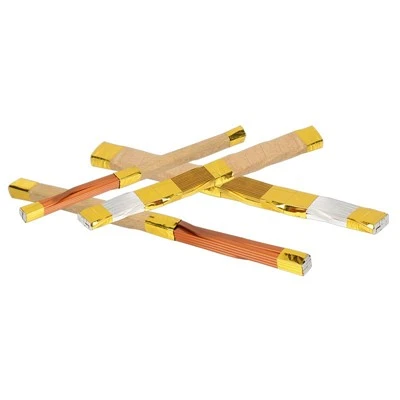
If you’ve ever worked with high-frequency electronics—whether it’s power inverters, transformers, or even those fancy wireless chargers—you’ve probably run into that annoying "skin effect" problem. You know the one: at higher frequencies, electrical current doesn’t spread evenly across a wire’s cross-section. Instead, it huddles near the outer surface, leaving the core unused. That might not seem like a big deal at first, but it kills efficiency, makes components run hotter, and can even mess up signal integrity. As a Litz wire supplier, I get asked about this all the time: how exactly does Litz wire fix the skin effect? Let’s break this down in plain terms, no stuffy textbooks here.
First, let’s make sure we’re all on the same page about skin effect. At low frequencies (like 50/60Hz for home power), current flows uniformly through a wire—all the metal inside the cross-section is doing work. But crank up the frequency, say to 10kHz or higher (super common in EV chargers, switch-mode power supplies, and RF gear), and electromagnetic induction starts playing tricks. The changing magnetic field inside the wire creates eddy currents that push the main current outward. The result? A thin "skin" of current on the wire’s surface, usually just a few millimeters thick (thinner at higher frequencies). For a solid copper wire, that means most of the metal is wasted—you’re paying for all that copper inside, but only using a tiny slice. Resistance goes up, which means more heat and less power gets where it needs to go. That’s a huge headache for anyone building high-frequency gear.
Now, Litz wire is basically the opposite of a solid wire. Instead of one thick strand, it’s made of hundreds or thousands of tiny, insulated copper strands twisted (or woven) together. The insulation between each strand is super thin—usually a coat of enamel, not much thicker than a human hair—so they don’t touch each other. Here’s where the magic happens: each tiny strand has a much smaller diameter than the skin depth at the frequency you’re working with. Remember that skin depth is how far the current penetrates; if a strand is smaller than that, the current can spread across almost the entire strand. That alone helps a lot, but we’re not done yet.
Wait, if the strands were just bundled together, would that work? Nope, not even a little. That’s where the twisting pattern comes in. At high frequencies, the magnetic fields from nearby strands would still cause current to clump on the outsides of the bundle, even for small strands. So we arrange the strands so that every single strand moves from the center of the bundle to the outside evenly. No strand stays in one spot all the time—over a given length of Litz wire, every strand spends an equal amount of time on the inside and the outside of the bundle. That evens out the current distribution across all strands, so no strand gets stuck carrying more current than it should. It’s like a rotating dance: each dancer (strand) switches positions, so no one gets stuck in the back and gets less air (current).
Let me throw in a quick real-world example to make this concrete. Suppose we’re making a transformer for a 50kW EV charger, which runs at around 20kHz. At 20kHz, the skin depth of copper is about 0.5mm. If we used a solid wire with a 2mm diameter, most of the wire is 1.5mm of unused copper—resistance would be way higher than the DC resistance, and we’d lose a ton of energy as heat. Instead, we use Litz wire with 100 strands, each 0.2mm in diameter. That’s way smaller than the 0.5mm skin depth, so each strand can carry current evenly. And since we twist the strands, none stay on the outside of the bundle long enough to get an unfair amount of current. The result? AC resistance drops by 30-50% compared to a solid wire of the same total copper weight—huge for efficiency.
But wait, Litz wire isn’t a magic bullet, right? There are a few things we have to consider. First, the strand diameter can’t be too big. If we used strands thicker than the skin depth, we’d still get some current crowding inside each individual strand, which defeats the purpose. Second, the twisting has to be done properly—too loose, and strands shift, leading to uneven current distribution; too tight, and you can stretch the strands, which might break the insulation or weaken the wire. Also, for very high frequencies (like MHz range, for RF applications), we need even smaller strands—sometimes just a few micrometers thick—because skin depth gets even smaller there. Oh, and don’t forget the insulation: if the enamel coating is too thick, it adds unnecessary bulk, but if it’s too thin, strands can short together, which brings us back to the skin effect problem.
As someone who’s been supplying Litz wire for over a decade, I’ve seen engineers make mistakes here all the time. One common one is trying to skimp on copper by using a thinner Litz wire than necessary, thinking they’re saving money, but ending up with overheating components that fail prematurely. Another is choosing the wrong strand size for their frequency—they grab a standard Litz bundle without checking the skin depth at their operating frequency, and it doesn’t perform as well as expected. That’s why we always ask for the frequency, current level, and application when someone reaches out—we don’t just sell a "one-size-fits-all" Litz wire; we tailor it to their exact needs.
Let’s talk about why this matters beyond just efficiency. For EVs, every watt saved translates to more range, which is a big deal for drivers. For renewable energy inverters, higher efficiency means more power from solar panels or wind turbines, which is better for the planet. Even consumer stuff like wireless charging pads—using Litz wire means they charge faster without getting hot, which is way more user-friendly. And as frequencies keep going up (we’re pushing 100kHz+ for next-gen power systems), the skin effect only gets worse, so Litz wire is becoming more essential than ever.
Now, I know some of you might be thinking: why not just use thicker solid wire? Well, thicker wire has more resistance even at low frequencies, but at high frequencies, the AC resistance of a thick wire skyrockets because of the skin effect. Litz wire’s total copper cross-section is the same as a solid wire, but since current is spread evenly across all strands, AC resistance is way lower. It’s like having a bunch of small pipes instead of one big pipe for water—more total surface area (which is what current likes at high frequencies) without the waste.
Another point: the twisting pattern. There are different types—like single twist, double twist, braiding—each for different frequencies and applications. Single twist is simple, good for lower kHz ranges. Double twist evens out strand positions more, which is better for higher frequencies. Braiding is even more uniform, great for RF or very high-power transformers. We work with our customers to pick the right twist type based on their operating conditions, because that’s where a lot of the performance comes from.
I should also mention that while Litz wire solves skin effect, it’s not the only factor at play in high-frequency design. You still have to consider proximity effect, which is when current in adjacent conductors pushes current around, but that’s a whole other conversation. For now, just know that Litz wire targets the skin effect directly, and does a way better job than solid wire.
As a supplier, I pride myself on not just selling a product, but helping customers understand what they need. I’ve had engineers come to me frustrated because their transformer was overheating at 30kHz, and after checking their design, we recommended switching from a 5mm solid wire to a Litz bundle with 200 0.3mm strands. The difference was night and day—AC resistance dropped 40%, their operating temperature went down 20°C, and they didn’t have to replace parts halfway through the project. That’s why I love what I do; it’s not just about moving wire, it’s about solving real problems for people building cool, high-tech stuff.

If you’re working on a project where skin effect is holding you back—whether it’s a power supply, transformer, inverter, or anything else high-frequency—reach out. I’m happy to chat through your needs, help you pick the right Litz wire, and answer any questions you have. No sales pitch, just straight talk about what works best for your application.
Rectangular Insulated Aluminum Stranded Cable References
- Electromagnetic Skin Effect and Proximity Effect in Conductors, IEEE Transactions on Power Electronics, 2018
- Litz Wire Design for High-Frequency Power Applications, Journal of Electronic Materials, 2020
- Skin Depth Calculations for Copper at Various Frequencies, National Renewable Energy Laboratory (NREL) Technical Report, 2019
Tianjin Jingwei Power Technology Co., Ltd.
As one of the most professional litz wire manufacturers and suppliers in China, our products have good reputation in the market. We warmly welcome you to buy durable litz wire for sale here from our factory. Good service and quality products are available.
Address: No.1 Chuangxin Rd. Xiaozhan Industrial Park, Jinnan District, Tianjin, China
E-mail: info@jwdc.cn
WebSite: https://www.jwdcs.com/
