If you’ve ever watched a four-station thermoforming machine in action—its heated sheets stretching tight over custom molds, cooling into precise packaging or component parts, and cutting clean every cycle—you know these aren’t just bulky metal boxes. They’re precision-engineered tools, and moving one isn’t like hauling a pallet of raw plastic sheeting. When I first started selling four-station thermoformers over a decade ago, I watched customers cut corners on transport and end up with cracked heating elements, misaligned mold stations, or even bent frames that cost thousands in repairs. That’s why I’ve spent years refining our transport process, and why today I’m breaking down exactly how to move one of these machines safely—from pre-transport prep to final installation checks—so you avoid the headaches that come with rushed or ill-planned moves. Four Station Thermoforming Machine

First, let’s get clear on what a four-station thermoforming machine is, because that context makes every transport step make sense. Unlike a single-station model, which only has one heating, forming, cooling, and cutting cycle, four-station machines have separate, rotating stations that let each process happen at the same time. That means more work gets done, but it also means more moving parts and tighter tolerances. A typical mid-sized model weighs between 12,000 and 18,000 pounds, measures 12 feet long, 8 feet wide, and 7 feet tall, and is packed with delicate components: quartz heating elements that can shatter if dropped, linear bearings that need perfect alignment, vacuum pumps that can crack from rough handling, and electronic control panels with circuit boards that short out from vibration. Skip a step here, and even a seemingly small jostle can turn a $50,000 machine into paperweight.
Pre-transport prep is where most mistakes happen, and I’ve seen customers skip this and regret it. First, you need to do a full machine inspection a week before move day. Disconnect all utilities first—power, compressed air, water lines, and any auxiliary equipment like material roll stands or part conveyors. Mark every connection with colored tape: red for power, blue for compressed air, green for water. This seems small, but when you’re setting up in a new factory, misconnecting a 480-volt power line can be dangerous, and misattaching a water line to a vacuum pump can ruin the pump in minutes. Next, secure all loose components inside the machine. The rotating station carousel, which weighs 2,000 pounds, is the biggest culprit here. Most modern machines have a lock mechanism for the carousel, but I still see people skip locking it and watch the carousel swing around during transport, slamming into the frame and bending the gear teeth. You should also remove or pad small, removable parts: heating elements should be taken out and wrapped in bubble wrap; control panel knobs, switches, and circuit board covers should be boxed and labeled clearly; even the mold inserts, which are custom for each customer, need to be crated separately to avoid nicks or breaks.
Then, you have to prepare the machine for lifting—this is non-negotiable. Thermoforming machines aren’t built with standard forklift pockets like a palletized load. Most have lifting lugs on the top frame, but you can’t just hook a chain on one and hoist it up. I always recommend using two sets of heavy-duty chain slings (rated for at least twice the machine’s weight, so if your machine is 15,000 pounds, slings rated for 30,000 pounds or more) and running them through the machine’s center of gravity. To find that, your machine’s manual will have a CG specification, but as a rule of thumb, it’s about 5 feet from the front edge of the frame, dead center. If you run slings too far forward or back, the machine will tilt, and you risk straining the frame or damaging internal parts. Also, never lift the machine by the control panel, the vacuum pump, or the mold base—those are delicate, and the frame is the only part designed to handle lifting. If you don’t have lifting lugs, we provide temporary lifting brackets for all our machines, and I always make sure our customers know to install those before any lift attempt.
Now, the transport itself—whether you’re moving it locally on a flatbed truck or cross-country on a semi-trailer, vibration and stability are your two biggest enemies. First, choose the right vehicle. For local moves under 50 miles, a flatbed truck with a soft suspension is best; for long moves, an enclosed semi-trailer or a lowboy trailer is ideal. Why? Thermoformers aren’t just heavy—they’re sensitive to the sway and vibration that comes with open flatbeds, especially at highway speeds. I’ve had a customer move a machine on an open flatbed and find a dozen quartz heating elements shattered because of constant wind vibration over 300 miles. Next, secure the machine properly on the trailer. Use four heavy-duty tie-downs (rated for at least 15,000 pounds each) attached to the machine’s frame, not the lifting lugs or any internal parts. Run the tie-downs diagonally from each corner of the trailer to the machine’s opposite corners—this is called “cross-tieing” and it prevents the machine from shifting forward, back, left, or right during transport. For the carousel, once it’s locked, add an extra small chain to the frame to keep it from rotating even a fraction; even a one-degree shift can throw off station alignment when you install it.
Vibration control is another key point. If you’re using an open trailer, add rubber anti-vibration mats under the machine’s feet—these aren’t just for installation; they absorb the road vibration that can loosen bolts, crack electrical connections, or damage internal bearings. For long moves, we also recommend placing a layer of foam padding between the machine’s frame and the trailer bed, especially on the edges where the machine might rub against the metal during turns. I once worked with a customer who skipped the mats and padding, and after a cross-country move, found that the machine’s linear guide rails were so loose from vibration that the forming station was off by a quarter of an inch—enough to ruin every part they made for a month after startup.
Once the machine arrives at its new location, the final installation step is where you confirm you did everything right. First, unload the machine slowly—no quick drops or sudden stops. If you’re using a forklift, make sure the forks are centered under the machine’s legs, not just slid under the front edge, to keep it balanced. Place the machine on a level, solid surface—thermoforming machines need a level base within 0.05 inches over the entire length of the frame. Most factories use concrete floors, but if the new space has a wooden or metal subfloor, you’ll need to add steel leveling plates under each machine foot to ensure it stays level. Next, recheck the components you removed: reinstall the heating elements carefully (don’t bend the terminals), test the carousel lock, and make sure all electrical and air connections are tight.
Then, do a test run with no raw plastic sheeting. Turn the machine on, run each station cycle separately, and check for unusual noises: grinding could mean misaligned bearings, rattling could mean loose internal bolts, and uneven rotation could mean the carousel wasn’t locked properly. We always offer a post-installation check for our customers, because even with all the right steps, a tiny misalignment can cause big problems. Last month, a customer I’d sold a machine to moved it on his own, and after unload, the carousel was 2 degrees off center—he didn’t notice until he ran a test, and it cost him a day of downtime to fix. If you’re not experienced with moving thermoforming machines, that’s why it’s worth partnering with a supplier who can handle the transport for you.
Let’s be honest: moving a four-station thermoforming machine is more work than it seems, but skimping on steps will only cost you more in the long run. As someone who’s been supplying these machines for over a decade, I’ve seen it all: customers who saved $500 on transport and ended up with $10,000 in repairs, and customers who followed the right steps and had their machine up and running in half a day. The difference is care. You don’t have to be a logistics expert—just follow the prep, lift, transport, and install steps I’ve laid out, and you’ll avoid the most common mistakes.
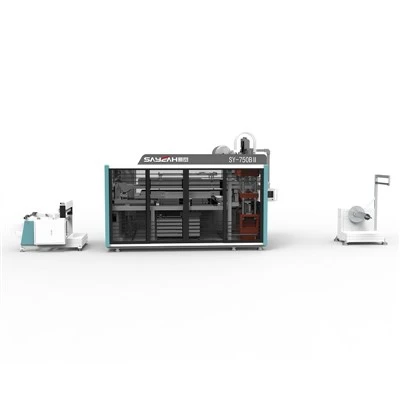
If you’re planning to move a four-station thermoforming machine, whether it’s a new one from our inventory or a used one you’re relocating, we can help. Our team has trained in safe transport techniques, works with vetted carriers who specialize in industrial equipment, and provides full pre and post-transport inspections to make sure your machine arrives in perfect working order. Reach out to our team to discuss your needs, and we’ll walk you through every step of the process to keep your investment safe.
Four Station Thermoforming Machine References
Thermoforming Machinery Safety Standards. Association of Industrial Machinery Manufacturers, 2022.
Installation and Transport Guidelines for Four-Station Thermoformers. Global Thermoforming Suppliers Network, 2021.
Industrial Equipment Transport Best Practices. National Heavy Trucking Association, 2023.
Zhejiang Sayeah Machinery Co., Ltd.
Zhejiang Sayeah Machinery Co., Ltd. is one of the most reliable manufacturers and suppliers of four station thermoforming machine in China, also supports high quality customized service. Please feel free to buy CE approved four station thermoforming machine from our factory. For price consultation, contact us.
Address: Wanquan District Industrial Zone,West Of China National Highway 104, Sunlou Village, Wanquan Town, Pingyang County, Zhejiang Province. China
E-mail: sales@sayeahmachinery.com
WebSite: https://www.sayeahthermoforming.com/
