If you’ve ever stood in a construction shop or on a manufacturing floor watching a hydraulic system whir and lift tons of material, you’ve probably taken for granted the hoses that make it all work. As a textile braid hydraulic hose supplier, I’ve spent my career talking to technicians, maintenance managers, and operators who ask one question more than any other: “What temperature range can these hoses actually handle?” It’s not just a random question—too hot, and the hose can soften, leak, or burst; too cold, and it can crack, stiffen, or fail mid-job. After thousands of hours testing these hoses with my team, and learning from the years of real-world projects we’ve supported, I want to break down this temperature range clearly, explain what factors impact it, and give you the context you need to pick the right hose for your work. Textile Braid Hydraulic Hose

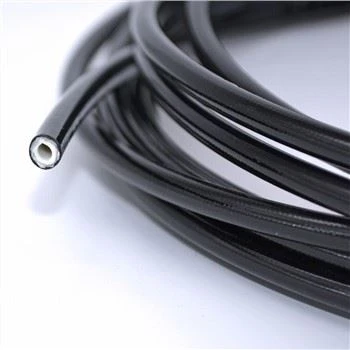
First, let’s get on the same page about what a textile braid hydraulic hose is, because that’s key to understanding its temperature limits. Unlike spiral hoses that use multiple layers of steel wire for super high pressure, textile braid hoses get their strength from one or two layers of tightly woven synthetic fiber—usually polyester, aramid, or sometimes nylon. These fibers are wrapped in a rubber cover (most often nitrile) that protects the braid from abrasion, chemicals, and the elements, plus an inner tube that holds the hydraulic fluid. That combination of textile reinforcement and rubber covers is what makes these hoses light, flexible, and perfect for low-to-medium pressure applications: think small excavator arms, farm equipment lift systems, hydraulic presses for small parts, or even marine steering lines. But because their core strength isn’t steel, their temperature limits are different from their heavy-duty steel-reinforced cousins, and that’s where a lot of people get tripped up.
So what’s the baseline temperature range for a standard textile braid hydraulic hose? From the lab tests we run in our in-house testing facility, most quality standard textile braid hoses perform reliably between -40°F (-40°C) and 250°F (121°C). Wait, that’s a wide range—so why do some hoses work in lower temperatures, and others only in hotter conditions? The answer boils down to two parts of the hose: the inner tube and the outer cover, both of which react differently to extreme temps. Let’s start with the cold end first, because that’s where a lot of winter outdoor operations run into trouble.
At temperatures below -40°F (-40°C), the synthetic textile braid starts to get brittle. Polyester, for example, loses its flexibility as temps drop because the molecular chains in the fiber stiffen—think of how a rubber band left in the freezer snaps when you pull it, that’s the same idea, just with fiber instead of rubber. The rubber outer cover, usually nitrile, also hardens in cold temps, so it can crack when the hose bends or moves. The inner tube, which holds the hydraulic fluid, is another factor here. If the fluid inside thickens or even gels when it’s too cold, it creates extra pressure that the hose wasn’t designed to handle, which can cause leaks or bursts. That’s why we always warn customers working in sub-zero temps to either use a cold-optimized textile braid hose, or pre-heat their hydraulic system before operating it at low temps.
On the hot end, the upper limit of 250°F (121°C) is standard for most general-purpose hoses, but push past that, and you start to see issues. When temperatures climb above that, the rubber cover and inner tube start to degrade. Nitrile rubber, which is resistant to most petroleum-based hydraulic fluids, breaks down when exposed to heat for too long—it gets soft, starts to swell, and loses its ability to hold pressure. The textile braid, meanwhile, can start to stretch or even melt if it’s exposed to temps higher than 250°F, because most synthetic fibers used in these hoses have a melting point around 400°F (204°C), but that doesn’t mean they can handle constant exposure to 250°F—extended heat exposure weakens the fiber’s strength over time, even if it doesn’t melt right away. We’ve had customers try to use standard textile braid hoses for hot oil transfer, and within six months, they were dealing with soft covers and leaking inner tubes because the heat was eating away at the materials.
But here’s the thing: that 250°F upper limit is for continuous operation. If a hose is only exposed to brief spikes in heat—like a one-time burst of hot fluid from a faulty valve, or a few minutes of being near a hot engine—they can handle temps up to 300°F (149°C) without permanent damage. We test all our hoses for short-term heat exposure, and that’s the number we publish for peak, non-continuous heat. But I always emphasize to customers: continuous operation above 250°F is a no-go for standard textile braid hoses. If you need something for constant high heat, you’d be better off moving to a spiral wire hose, or a specialty textile braid hose with a heat-resistant cover.
Speaking of specialty hoses, not all textile braid hydraulic hoses are the same. We make three main variants for different temperature ranges, and that’s a big part of what we help customers navigate when they reach out to us. First, there’s our standard range, which hits that -40°F to 250°F sweet spot for most indoor and moderate outdoor applications. That’s what we stock most of because it works for 70% of the textile braid hose requests we get—small farm equipment, light industrial machinery, recreational vehicle hydraulics, that kind of work.
Then we have our cold-optimized textile braid hose, designed for temps as low as -65°F (-54°C). We developed this after a big client in northern Canada came to us last year, saying their standard hoses were cracking every winter when they used their forestry lift equipment in -50°F weather. The difference here is in both the braid and the cover: we use a modified polyester fiber that’s treated to stay flexible at much lower temps, and a special nitrile cover that doesn’t harden when the mercury drops. We tested these hoses in a cryogenic chamber, bending them thousands of times at -60°F, and they didn’t crack or lose any pressure rating—so that’s the go-to for anyone working in cold climates.
On the other end, we have our heat-resistant textile braid hose, built for continuous temps up to 300°F (149°C), with short bursts up to 350°F (177°C). These are for customers working in places like food processing plants, where hydraulic lines are near hot ovens or cooking systems, or for diesel engine applications where the lines are close to exhaust manifolds. Instead of standard nitrile, we use a specially formulated EPDM rubber cover that stands up to heat, and an inner tube made of a heat-resistant synthetic rubber that doesn’t break down when exposed to hot fluids. We’ve had a bread manufacturing client use these hoses for two years now, running next to 400°F baking ovens, and they haven’t had a single failure from heat exposure.
Now, I know a lot of customers will look at these ranges and think, “Can I push it a little? What happens if I use a standard hose in 260°F weather?” The honest answer is: sometimes you get away with it for a few weeks, sometimes you have a hose burst mid-operation and cause thousands of dollars in damage. I’ve seen it firsthand—last year, a landscaping company used our standard hose for a power washer that ran hot, and within three weeks, the cover softened, the hose swelled, and it burst while they were washing a building, spraying hot water onto a nearby window and siding. The damage cost them more than the hoses would have if they’d bought the right ones. That’s why it’s not just about the temperature number—it’s about how you’re using the hose, and for how long.
Another big factor that most people don’t talk about is the type of hydraulic fluid you’re using. If you’re running a standard petroleum-based hydraulic fluid, that can change the temperature performance too. Synthetic hydraulic fluids, for example, have higher boiling points and don’t thicken as much in cold temps, so a hose used with synthetic fluid can often handle a 10°F to 15°F lower temp than the same hose with petroleum fluid. We always ask customers what fluid they’re using when they reach out to us, because that small detail can change which hose they need.
There’s also the issue of pressure, which ties back to temperature. When a hydraulic hose is under higher pressure, the internal temperature can rise even if the fluid entering the hose is at a moderate temp. For example, a hose carrying fluid at 2000 PSI will run hotter than the same hose carrying fluid at 1000 PSI, even if the fluid is entering at 180°F. That’s because the pressure creates friction inside the hose, which generates heat. So if you’re using your textile braid hose for medium pressure applications (which is most of them, since they max out around 3000 PSI), you need to account for that built-in heat when calculating your operating temperature.
I’ve been supplying textile braid hydraulic hoses for over 15 years now, and the mistake I see most often is customers assuming all hoses have the same temperature range. I can’t tell you how many times someone will call me and say, “I bought these hoses online, they said they work down to -20°F, but they cracked last week in -25°F.” A lot of cheap hoses from overseas cut corners on the materials—they use lower grade rubber that hardens faster in cold, or polyester braid that’s not treated, so it gets brittle. That’s why, as a supplier, we test every single batch of hoses we sell, both in the lab and in real-world field tests, before we send them out. We don’t just go by the printed number on the hose—we make sure it works when you need it to.
Let’s wrap this up with a few key takeaways that I wish every person using a textile braid hydraulic hose knew. First, standard textile braid hoses operate reliably between -40°F (-40°C) and 250°F (121°C) for continuous use, with short heat spikes up to 300°F (149°C). Second, if you work in temps below -40°F, you need a cold-optimized hose, and if you’re exposed to constant heat near or above 250°F, go for a heat-resistant variant. Third, factors like hydraulic fluid type, operating pressure, and how long you’re running the hose all affect how it performs in extreme temps—those numbers aren’t set in stone.
At the end of the day, picking the right hose isn’t just about saving a few dollars upfront. It’s about avoiding downtime, preventing damage to your equipment and property, and keeping your team safe. If you’re not sure which temperature range you need, or you want to talk about custom hoses for your specific application, don’t hesitate to reach out to us. We’ve worked with small farms, large construction companies, and everything in between, and we can help you find the exact textile braid hydraulic hose that fits your needs. Whether you need a cold-optimized hose for northern winter work, a heat-resistant hose for industrial applications, or the standard range for your everyday projects, we’ve got you covered.
EN Standard Hydraulic Hose References:
- Society of Automotive Engineers (SAE). Standard for Textile Braid Hydraulic Hoses. SAE International, 2021.
- Rubber Chemistry and Technology. Temperature Dependence of Synthetic Fiber Reinforcements in Hydraulic Hoses, Vol. 93, No. 2, 2020, pp. 245-262.
- International Organization for Standardization (ISO). Hydraulic Fluid Power – Hoses and Hose Assemblies – Test Methods, ISO 1436:2019.
- Parker Hannifin Corporation. Hydraulic Hose Selection Guide: Temperature and Material Compatibility. Parker Hannifin, 2022.
Hebei Qianli Rubber Products Co., Ltd.
As one of the most professional textile braid hydraulic hose manufacturers and suppliers in China, we have world-leading production equipment and strong manufacturing capabilities. Please feel free to buy bulk durable textile braid hydraulic hose made in China here from our factory.
Address: West industrial Zone, Jing County, Hengshui City, Hebei Province, China.
E-mail: manager@hebeiqianli.com
WebSite: https://www.qianlirubber.com/
